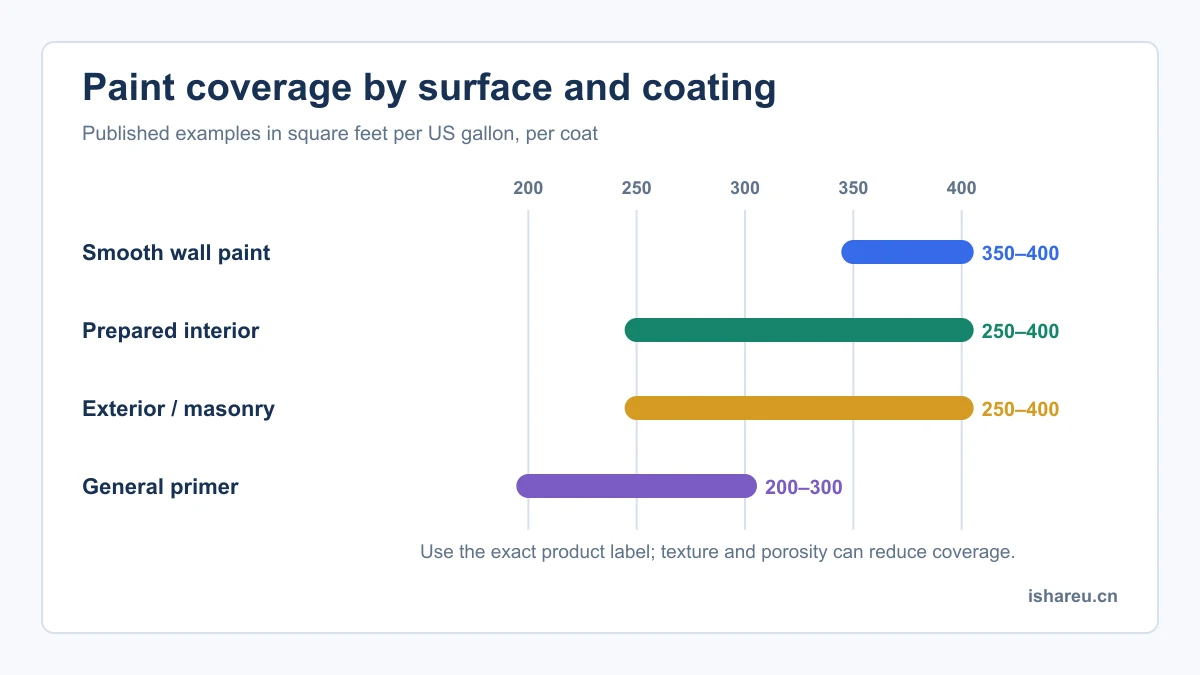
Many wall paints publish 250–400 sq ft per gallon per coat, while a smooth-wall planning estimate often uses 350–400. Primer commonly starts around 200–300 sq ft per gallon, and 12 oz spray products can differ sharply—from 8–12 to 20–25 sq ft per can in the examples below. Always replace a planning default with the current label value for the product you will buy.
Data verified: August 29, 2026. Coverage is shown per coat unless the source states otherwise. This chart compares published examples; it is not a promise that every coating in a category performs at the same rate.
The public repository contains the versioned dataset, source URLs, validation checks, and methodology so the figures can be audited or reused.
Coverage by coating and surface
| Coating | Surface / use | Published example | Calculator planning default | Main qualification | Source |
|---|---|---|---|---|---|
| Interior finish paint | Smooth, prepared wall | 350–400 sq ft/gal | 375 sq ft/gal | One coat; use the label range when available | Sherwin-Williams calculator FAQ |
| Interior finish paint | Prepared interior surfaces | 250–400 sq ft/gal | 350 sq ft/gal | Texture, porosity, color and application method can lower coverage | Behr Ultra Interior |
| Ceiling paint | Prepared ceiling | 250–400 sq ft/gal | 350 sq ft/gal | Texture, bare drywall and stains may require primer or more material | Behr Ultra Ceiling Paint |
| Exterior paint | Wood, siding, masonry or fence | 250–400 sq ft/gal | 300 sq ft/gal | Weathered, rough or porous surfaces belong near the low end | Behr Pro e600 Exterior |
| Masonry paint | Brick, stucco or masonry | 250–400 sq ft/gal | 250 sq ft/gal | Manufacturer detail lists about 250–300 on rough and up to 400 on smooth surfaces | Behr Masonry, Stucco & Brick |
| General primer | Prepared substrate | 200–300 sq ft/gal | 250 sq ft/gal | Conservative midpoint until the exact primer and substrate are known | Sherwin-Williams calculator FAQ |
| Multi-surface primer | Drywall, wood, masonry or metal | 250–400 sq ft/gal | 300 sq ft/gal | A product-specific example; block fillers can cover much less | Behr Multi-Surface Primer |
| General-purpose spray paint | Compatible smooth object | 25 sq ft/12 oz can | 20 sq ft/can | Published product value; the lower planning default allows for practical variation | Krylon COLORmaxx |
| High-build spray paint | Compatible smooth object | 8–12 sq ft/12 oz can | Use product label | Technical sheet assumes 15% material loss at its recommended film thickness | Rust-Oleum Painter’s Touch 2X |
How to use the chart
- Find the exact coverage on the product label or current technical data sheet.
- Use that number in the appropriate calculator. If you have not selected a product, use the conservative planning default—not the highest published value.
- Multiply paintable area by the number of coats before dividing by coverage.
- Keep coverage, application loss and touch-up reserve as separate assumptions so the estimate remains auditable.
Coating area = paintable area × coatsQuantity = coating area ÷ label coverageWhat the comparison actually shows
Smooth walls versus texture
There is no universal “textured wall multiplier” printed on every label. The Behr examples explicitly say coverage changes with texture, porosity and application method; its masonry detail narrows that distinction to roughly 250–300 sq ft per gallon on rough surfaces and up to 400 on smooth surfaces. That evidence supports using the lower end for brick, stucco and heavy texture without presenting one reduction factor as a manufacturer guarantee. For those substrates, use the brick, masonry and stucco calculator to keep primer and finish coverage separate.
Wood and fences
The exterior-paint example covers prepared wood and fences within a broad 250–400 sq ft per gallon range. Weathering, end grain, gaps and painting both faces can matter more than the nominal linear length. Use the fence paint calculator to model faces, openness, coats and waste separately.
Primer is not finish paint
The general Sherwin-Williams reference is 200–300 sq ft per gallon, while the cited Behr multi-surface primer publishes 250–400. Those are not contradictory: primer formulation and substrate differ. The primer calculator therefore lets you enter the selected product’s rate instead of borrowing the finish-paint value.
Spray can size is not a coverage rating
Two cited 12 oz products publish very different practical coverage. Film thickness, solids, nozzle, color, shape and overspray all influence the result. Use the can’s own label in the spray paint calculator; see the spray coverage guide for irregular-object examples.
Calculator defaults and limitations
The defaults are deliberately planning values rather than claimed averages across the whole market. Interior and ceiling estimates use 350 sq ft per gallon; exterior uses 300; primer uses 250; masonry uses 250; and general-purpose spray planning starts at 20 sq ft per can. The live tools expose these fields so a product label can override each value. The primer calculator also explains the wider 200–400 sq ft product span: 250 is its conservative starting value, while sealed surfaces and specific multi-surface products may publish higher rates. Coverage describes spread rate, not whether one coat will hide a strong color change.
For a general room estimate, use the paint calculator. For overhead work use the ceiling calculator; for siding and façades use the exterior calculator.
Primary sources
- Sherwin-Williams paint calculator FAQ — smooth-wall, primer and spray-can planning references.
- Behr Ultra Interior — 250–400 sq ft per gallon.
- Behr Ultra Ceiling Paint — 250–400 sq ft per gallon with surface qualifications.
- Behr Pro e600 Exterior Flat — 250–400 sq ft per gallon.
- Behr Masonry, Stucco & Brick Flat — masonry coverage range.
- Behr Multi-Surface Primer — 250–400 sq ft per gallon.
- Krylon COLORmaxx — 25 sq ft per 12 oz can.
- Rust-Oleum Painter’s Touch 2X technical data — 8–12 sq ft per 12 oz can at recommended film thickness.
