The 12 oz product examples below span 8–25 square feet (sq ft) per can. Sherwin-Williams gives 20 sq ft as a general estimate for an 11 or 12 oz can. Use the exact product's coverage and coating instructions. Two full coats halve the project area only when the stated coverage is for one full coat.
11 oz and 12 oz spray paint coverage
| Question | Useful planning answer |
|---|---|
| How much will one can of spray paint cover? | The full-size product examples below range from 8–25 sq ft; use the exact label for the calculation. |
| How much does a 12 oz spray can cover? | Examples range from 8–12 sq ft for Rust-Oleum Painter's Touch 2X to 25 sq ft for Krylon COLORmaxx. |
| How much does an 11 oz spray can cover? | Sherwin-Williams gives a general 20 sq ft estimate; Krylon Fluorescent lists 10–20 sq ft with a separate white base coat. Check the exact product and coverage basis. |
| How many cans do I need? | Surface × items × sides × coats × overspray factor ÷ label coverage, rounded up. |
Calculate cans for your project after choosing the coverage printed on your product.
These figures describe product coverage under the stated application conditions. If 20 sq ft means one full coat, two full coats finish 10 sq ft before extra loss. If the label defines coverage for the complete specified finish, that figure already includes the required film build.
Coverage depends on the exact spray paint
Container weight is not enough to predict coverage. Formulation, pigment, nozzle pattern, required film thickness, color, and intended use can change the published figure even when cans look similar. The product-level comparison below ranges from 8–12 sq ft for one 12 oz Rust-Oleum specification to 25 sq ft for a 12 oz Krylon general-purpose example. These are product specifications, not brand-wide averages or a promise that every surface will achieve the maximum.
| Manufacturer example | Can size | Published coverage | Planning lesson |
|---|---|---|---|
| Krylon Fluorescent Paint | 11 oz | 10–20 sq ft/can | A specialty example, not the average for all 11 oz cans; the specified white basecoat is separate |
| Rust-Oleum Painter's Touch 2X Ultra Cover | 12 oz | 8–12 sq ft/can | Recommended film thickness changes the useful comparison |
| Rust-Oleum Professional High Performance Enamel | 15 oz | About 14 sq ft/can | A larger can does not guarantee a larger spread rate |
| Krylon COLORmaxx Paint + Primer | 12 oz | 25 sq ft/can | Use 25 only when it matches the selected product |
| Krylon COLORmaxx Primer | 12 oz | 20–25 sq ft/can | A range calls for a conservative input |
| Krylon Lacquer Spray | 12 oz | 15–20 sq ft/can | Equal can weight does not mean equal coverage |
| Krylon Short Cuts | 3 oz | 1–3 sq ft/can | Small craft cans should not inherit a full-size default |
Download the product coverage data as CSV →
Product pages and labels can change. Confirm the current label before purchasing, and follow its preparation, application, ventilation, personal protective equipment, recoat, and disposal instructions. The downloadable table records the source review date and keeps minimum and maximum coverage separate.
How to calculate spray paint cans
Coated area = measured area × items × sprayed sides × coatsCans = coated area × (1 + overspray allowance) ÷ label coverage per canAlways round the calculated can count up to a whole can. Keep overspray separate from the label coverage so the assumptions remain visible. If the manufacturer's stated coverage already reflects a particular application method, do not silently count the same loss twice.
Light spray passes are not always separate full coats
Rust-Oleum's technical data specifies a dry-film thickness per coat and recommends two or more light applications. Several light passes can build the required thickness of one full coat. Count complete coats at the coverage's stated film thickness, not every pass of the nozzle. When the label's coverage is for the complete specified finish, choose that coverage basis in the calculator so it is not multiplied again. The worked examples below assume coverage per full coat.
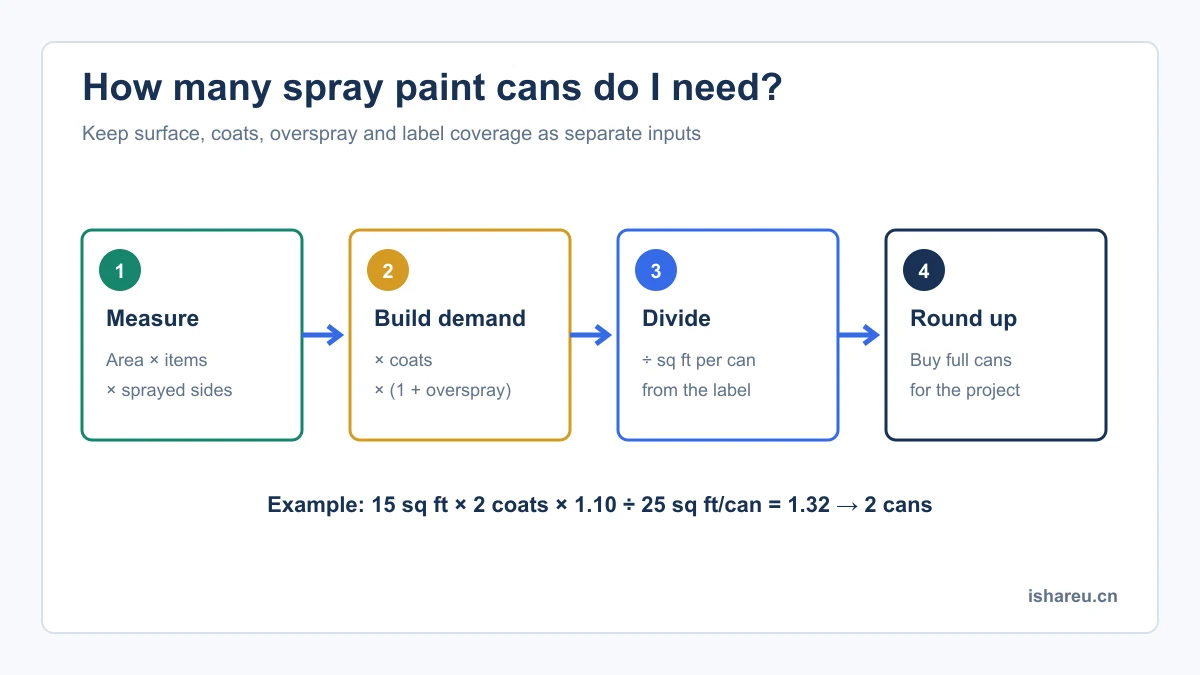

Worked spray-paint coverage examples
One flat 3 × 5 ft panel
One side of the panel is 15 sq ft. For two coats and 10% overspray, the coating demand is 15 × 2 × 1.10 = 33 coverage-square-feet. With a label value of 25 sq ft per can, 33 ÷ 25 = 1.32 cans, so the practical purchase is 2 cans. Spraying both sides would double the measured surface before coats and allowance.
Four cabinet doors, front and back
If each door measures 2 × 3 ft, one face is 6 sq ft. Four doors sprayed on both sides create 48 sq ft of actual surface. Two coats and 20% allowance produce 48 × 2 × 1.20 = 115.2 coverage-square-feet. At 25 sq ft per can, the result is 4.61, so buy 5 cans. Measure important edges separately if their combined area is material.
An open metal railing
A railing cannot be estimated reliably from its rectangular outline because much of that outline is empty space, while narrow bars expose several faces. Break the assembly into rails, posts, and pickets; estimate their exposed surface; then use a larger transfer-loss allowance if a test pass or the product guidance supports it. The spray paint calculator includes flat, furniture/rail, and intricate-shape presets while leaving the percentage editable.
Why real coverage can be lower
- More than one coat: two complete coats approximately double the coating area.
- Multiple faces: the front dimensions do not include the back, edges, legs, or undersides.
- Open or intricate shapes: some spray passes through gaps instead of landing on the project.
- Rough or porous surfaces: texture and absorption can require more material than a smooth sealed panel.
- Color change and hiding: achieving an even appearance may require another coat even when the nominal area is covered.
- Technique and conditions: distance, angle, wind, temperature, and nozzle control affect transfer and finish quality.
Do not compensate for every uncertainty by adding arbitrary percentages. Start with the exact product label, measure the project, and adjust only for conditions that actually apply. A small test area is more useful than a universal online coverage claim.
Frequently asked questions
How many square feet does a 12 oz spray paint can cover?
Official 12 oz examples on this page range from 8–12 sq ft for Rust-Oleum Painter's Touch 2X to 25 sq ft for Krylon COLORmaxx. Use the exact product's coverage and film-thickness instructions; can weight alone does not guarantee coverage.
How much does an 11 oz spray paint can cover?
Sherwin-Williams uses 20 sq ft as a general estimate for an 11 or 12 oz can. Krylon Fluorescent lists 10–20 sq ft for its 11 oz can, with a separate white base-coat requirement. Confirm the exact product's coverage basis rather than scaling a 12 oz estimate.
Does the stated coverage include two coats?
Check the stated coverage basis. Multiple light spray passes may build one full coat. Multiply by full coats only when the stated coverage is per coat; if it covers the complete specified finish, do not multiply it again.
How many spray cans do I need?
Measure all exposed surfaces once. Multiply by full coats only for per-coat coverage, add losses not already included in the label coverage, divide by coverage per can, and round up.
Should I add an extra can?
Round the calculation up first. An additional can can be sensible when the result is close to the purchased capacity, the shape is difficult, the color must match, or returning for the same batch would be costly. It should not replace measuring the project.
Can I estimate furniture from length × width?
Only for a flat face. Furniture also has sides, edges, shelves, legs, backs, and undersides. Break it into measurable surfaces or use a test-based allowance rather than treating those surfaces as zero.
Sources and methodology
Sherwin-Williams paint calculator FAQ supports the general 11/12 oz comparison. Krylon Fluorescent Paint technical data gives the 11 oz specialty example. Neither is a guarantee for every can with the same weight.
- Rust-Oleum Painter's Touch 2X technical data — 12 oz coverage range at recommended film thickness.
- Rust-Oleum Professional Enamel technical data — 15 oz coverage example.
- Krylon COLORmaxx Paint + Primer — 12 oz product coverage example.
- Krylon COLORmaxx Primer — 12 oz primer coverage range.
- Krylon Lacquer Spray — a lower-coverage 12 oz example.
- Krylon Short Cuts — smaller 3 oz craft-can example.
Source review date: October 4, 2026 for the 11 oz reference and coverage-basis explanation; other product rows retain their individual review dates in the CSV. The examples compare published product specifications; the quantity formula keeps measured surface, sprayed sides, full coats, overspray allowance, and label coverage separate.
Related planning tools
Use the spray paint calculator for cans and cost. For larger brush, roller, or airless-spray projects, use the exterior paint calculator or fence paint and stain calculator with the selected coating's gallon coverage.
